
BLOG
Photograph captions – as important as the pic!
Some tips on how to captions photos in your news articles, reports and on your website.
While it is said that a “picture is worth a thousand words”, a catchy and informative photo caption can explain the context of a picture, tell a story or draw a reader’s attention to a visual detail. A photo caption is the descriptive title under a photograph. Typically, captions will describe what is in the photograph, names the people in the photo or makes a comment on the content of the photo. A good photo caption can turn a good photo into an outstanding one.
But, here’s the thing about captions: they always need to be written after the photo is taken, and often by someone who didn’t take the photo. It is important therefore to make sure that the relevant information is available to be able to accurately caption a photograph.
This is especially relevant for photographs of people. Captions need to correctly identify people in photos, and this means that names, titles and relevant information about the people in the photos needs to be recorded. If people are standing in a row, the names need to be in order. It often happens that once a photo is taken, you may not have the opportunity of seeing the people again, as
so getting the names correct AT THE TIME OF TAKING THE PHOTO, is critical.
Here are a few tips for captioning photos of people:
1. Make sure that you have the correct titles – Mr, Mrs, Dr, Prof, Rev – for people in your photo, and the correct spelling of their names.
2. Make sure that you record the correct order, or the position in a photo of people so that you can identify them for a reader with words like “Standing left”, “Seated in the centre”, and so on. It is useful to draw a “map” of your photo to write the names, e.g.
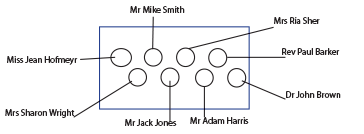
The caption for this photo will be something like this :
Seen last night at the Community Awards Evening held by the City Council, standing behind left, Miss Jean Hofmeyr, Mr Mike Smith and Mrs Ria Sher. Seated front left to right, Mrs Sharon Wright, Mr Jack Jones, Mr Adam Harris and Dr John Brown. Mr Jack Jones won the award for Best Community Initiative.
The most important thing is TO GET THE NAMES OF THE PEOPLE IN YOUR PHOTO AT THE TIME OF TAKING THE PHOTO – IF POSSIBLE. There is nothing worse that sitting with a photo after the event, not knowing the names of the people, and not having any contact details to get the names or check that you’ve got them right. (Bitter experience talking here!)
Use position markers like, Standing left, Seated centre, Back row, from left to right, Front from left to right. Try to make it easy for readers to identify people in the photo if they are not standing in an easily descibed format. In these cases, add small details like: in the red hat, wearing the blue mask, – and so on.
3. Use a photo caption as a mini story if you don’t have a good article to go with it. Sometime, a photo really does tell the whole story, and you can make the caption count by including all the information in the caption. Newspapers will often print a well-captioned photo rather than an article. and example of a good ‘story caption’ is here:In this caption, all the relevant information is provided without an accompanying article.
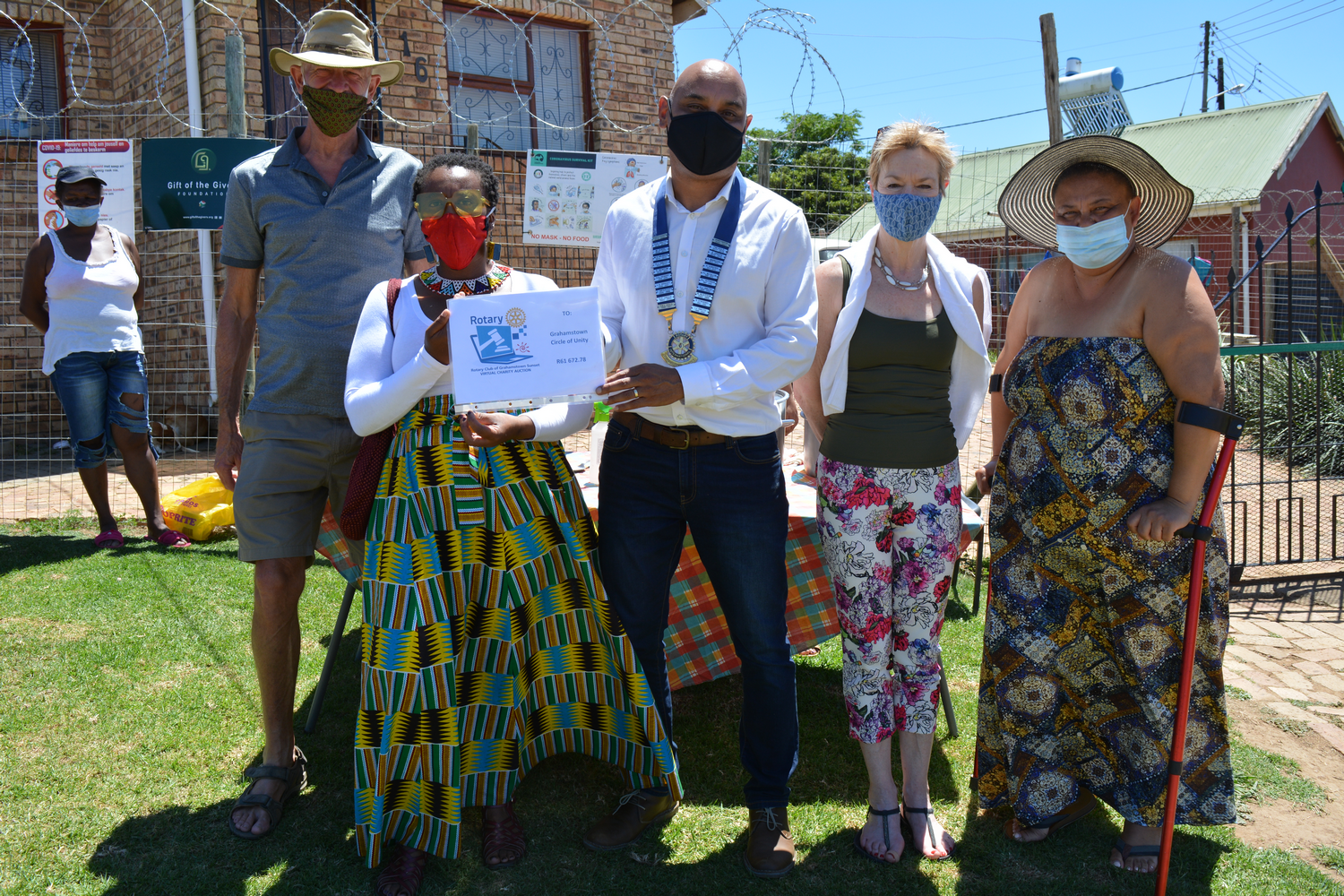
CHARITY AUCTION PROCEEDS FOR COMMUNITY KITCHENS
The Rotary Club of Grahamstown Sunset’s recently held a Charity Auction for the community kitchens run by the Makhanda Circle of Unity. Here they are handing over the proceeds, pictured left to right, Tim Bull, Grahamstown Residents Association, Ntuthu Blow, Administrator of the Grahamstown Residents’ Association, President of the Grahamstown Sunset Rotary Club, Javier Martin, fundraiser Sally Price-Smith and Dianne Oosthuizen who runs a community kitchen from her home. Oosthuizen provides soup, prepared in her makeshift kitchen to more than 200 people twice a week.
4. Make sure that the tone of your caption, matches the tone of your photo. Being humorous when a photo depicts a serious or sad situation is inappropriate. This doesn’t mean that humour is not good! Sometimes a humorous caption makes for excellent reading!
5. Try to add context to your photograph in the caption – don’t just explain the obvious that the reader can see for themselves. Obviously identifying the people in the photograph, what they are doing and why. Give extra value / information to the reader.
6. Write your caption in as if you’re describing the photo to a friend or relative. This helps you to focus your thoughts, and also to find the right conversational tone for your caption.